We are starting a series that highlights apps people build on Server4Agent. This is the first one. It was built by Mark, who was happy for us to share it, so here is what it is, how it came together and what it took to keep it running.
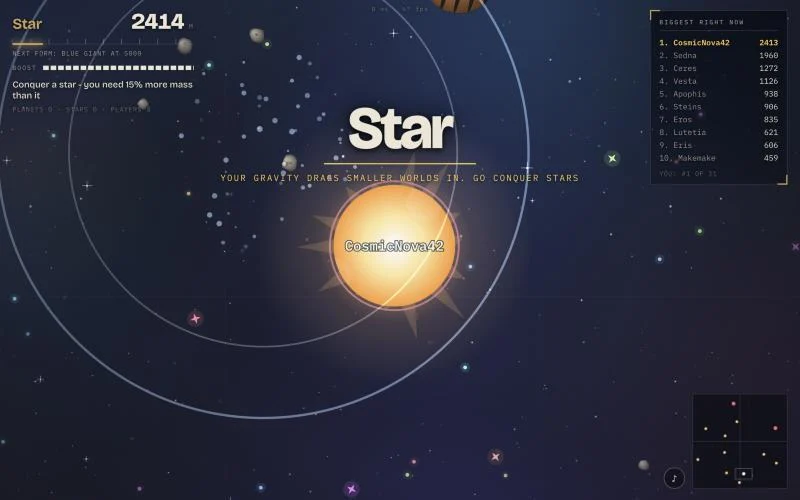
The app is agalaxy.io, a real-time multiplayer game that runs in the browser. You start as an asteroid, absorb anything smaller than you, avoid anything bigger, and grow through eight forms until you are a galaxy. It was built in a single conversation with Claude Fable 5.2, with Server4Agent connected so the assistant could put it online by itself.
Quick answer
A multiplayer game needs a process that stays running and holds the shared world, which is the part a chat window cannot give you. Here the assistant wrote a Node.js game server, started it on a Server4Agent project and deployed it to a public link. After that, every change Mark asked for went from a sentence in chat to the live game in a few minutes.
Key facts
| What it is | Real-time multiplayer browser game, up to 60 players in one world |
| Play it | agalaxy.apps.server4agent.com |
| Built with | Claude Fable 5.2, in one conversation |
| Server | Node.js, one dependency (ws), 751 lines |
| Client | Plain JavaScript on a canvas, 1,048 lines, no framework and no image files |
| Network | Server simulates 30 times a second and sends 15 updates a second over WebSocket |
| Measured traffic | About 4 to 5 KB a second per player, from a scripted test player |
| Updates after launch | Six, in the 54 minutes after it first went live |
The request
Mark's whole brief was one paragraph. Lightly tidied, it said:
I'd like to create a browser game where you start as an asteroid and have to run into other dust and asteroids to grow in mass, and conquer new stars, planets and galaxies, in order. Do some research first, because the game has to be very playable and enjoyable. When you're done we will deploy it on Server4Agent.
No stack, no design, no rules beyond that.
Research before code
The assistant began by reading about why this kind of game works. The points it took into the design were:
- Start in seconds. One name field and one button. No sign-up.
- Risk against reward. Growing is the goal and also what makes you a target.
- Something to feel good about inside three minutes. The first evolution comes within about a minute.
- A live leaderboard that resets, and personal stats that do not.
- A world that is never empty. Bots keep the arena busy when few people are online.
How it is built
The server owns the truth. Browsers only send where the player is steering, and the server works out every position, every collision and who ate whom. That one decision is what stops players from cheating by editing their own copy of the game.
The browser draws what the server tells it, a little in the past, and slides smoothly between updates so that 15 messages a second look like fluid motion.
Everything on screen is drawn by code: the tumbling asteroids, planets with drifting continents and orbiting moons, stars with turning flares, black holes with a swirling disc, and a spiral galaxy. Sound is synthesized in the browser too.
Player stats are saved in a single JSON file in the project folder. Each browser gets a random token that identifies its profile, so there are no accounts and no passwords.
Putting it online
With Server4Agent connected, going live was a short sequence the assistant ran without leaving the chat:
- Create a project, which gave the game its own address.
- Write the files to the server.
- Run
npm installthere. - Start the app with
node server.json the project's port. - Deploy, which made the address public.
It then checked its own work from outside: it loaded the page, called the leaderboard, and connected a scripted player over a secure WebSocket to confirm that game updates were really arriving. WebSockets worked on the project address with no extra setup.
For later updates the assistant packed the game into a small archive and sent it to a one-time receiver it ran on the project's port, then restarted the game. Each update took the game offline for under a minute.
Shaped by playing it
The first version was playable. What made it good was Mark playing it and saying what felt wrong. Each of these was a short message in the same chat:
- "Bigger masses should attract and eat you." Anything at least 20% heavier now pulls you toward it. The pull is scaled to your own top speed, so you can always escape if you react.
- "Boost should be limited." Boost became a fuel tank: about 2.5 seconds of thrust and about 11 seconds to refill.
- "Gravity should feel more real." Asteroids and comets now fall toward planets and stars, swing past them and sometimes crash. Nearly half of all asteroids are born in orbit.
- "Space should split you." Your front half lunges ahead as a second body and rejoins a few seconds later. Bots do it too.
- "The game should never end." Reaching 30,000 mass used to finish the run. Now you become a galaxy and keep playing.
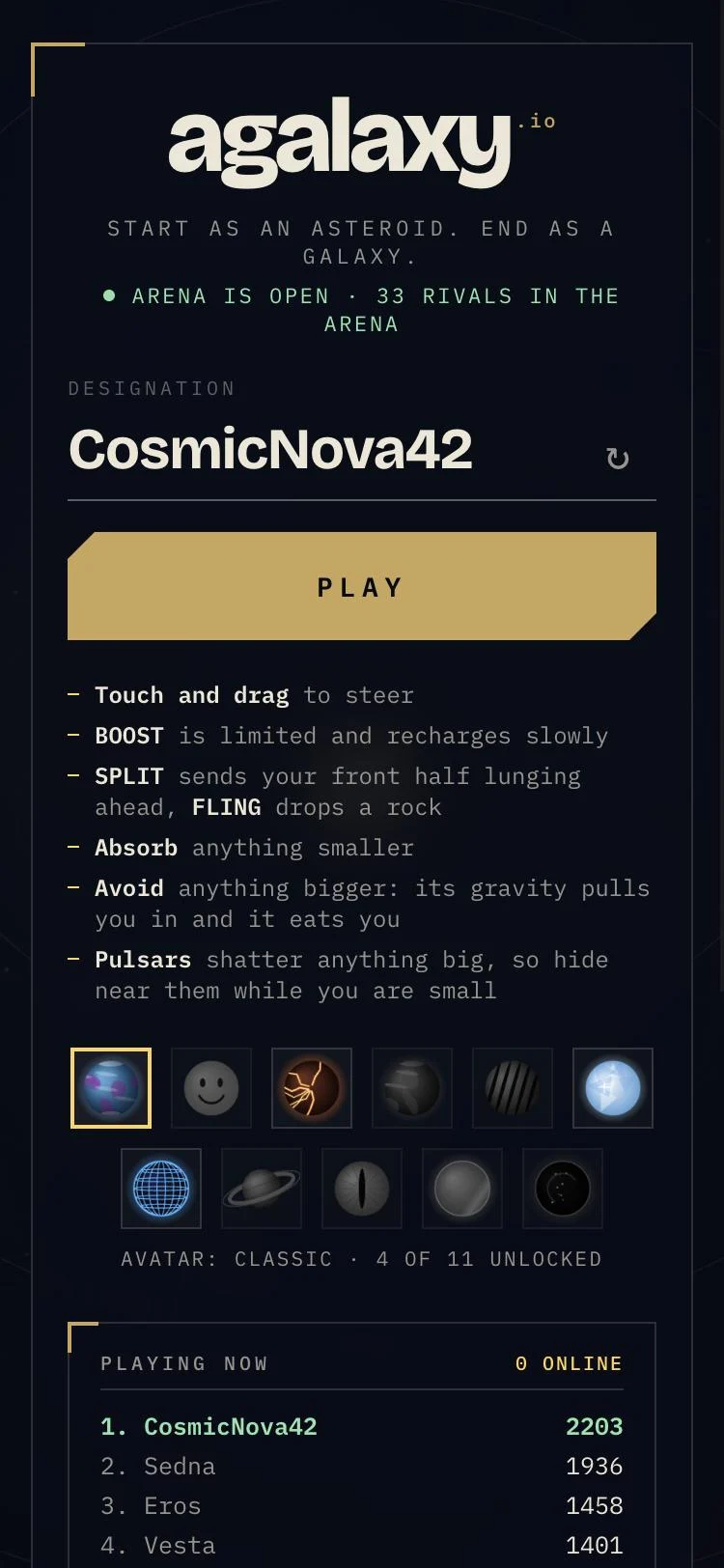
- "Not everyone should look the same." Eleven avatars unlock through accomplishments, such as conquering five planets or becoming a black hole.
- "Mobile does not let me enter my name." The menu was taller than a phone screen and was centred, which pushed the name field off the top. One layout fix.
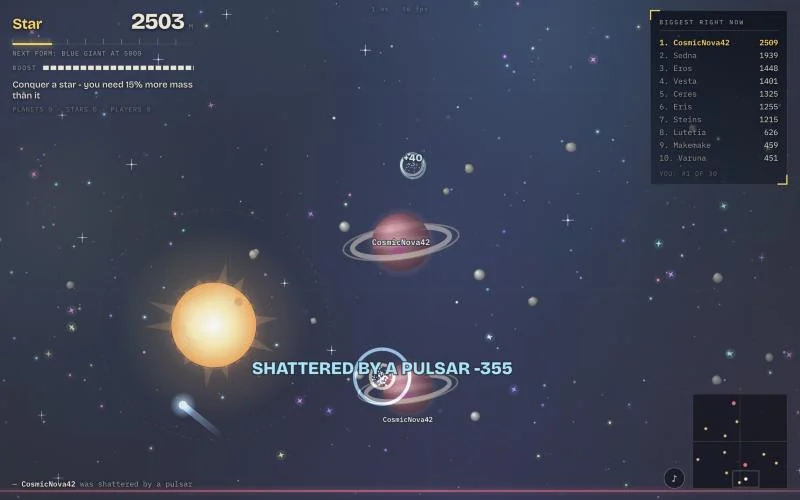
The last request was about looks: the default dark theme felt generic. The redesign gave the interface one accent colour that means something. It is the colour of the form you currently are, so the whole screen shifts from brass to teal to yellow to violet as you grow.
What is still rough
This is a game made in an evening, and it shows in places:
- Balance is a first pass. Nobody has tuned how long each form should take.
- Stats live in one file. That is fine for a small community and would need a database for a large one.
- Profiles belong to a browser. Clear your browser data and your avatars are gone.
- Phones were checked at phone size in a desktop browser more than on real devices.
Why this is worth showing
Most things people ask an assistant to build are pages and tools that answer when you open them. A multiplayer game is different: it has to be running when nobody is looking, hold state that every player shares, and keep long-lived connections open. That is exactly what a server is for, and it is why this build would have stopped at a code listing without one.
If you have built something on Server4Agent that you would like us to feature, tell us. The showcase has more examples.
FAQ
Can an AI assistant build a real-time multiplayer game?
Yes, if it has somewhere to run the game server. In this build Claude Fable 5.2 wrote the server and the browser client, started the server on Server4Agent and deployed it to a public address in one conversation.
Do WebSockets work on a Server4Agent project?
Yes. agalaxy.io keeps a secure WebSocket open to every player on its normal project address, with no extra configuration.
How many players can it hold?
The game allows up to 60 human players in one world and fills the rest with bots, between 12 and 30 depending on how many people are online. We have not load-tested it with 60 real players.
Did someone write the code by hand?
No. Mark described what he wanted and reported what felt wrong while playing. The assistant wrote and deployed every change.
Is the game free to play?
Yes. Open the link, keep or change the generated name, and press Play.
Related reading
- Build a mini game with Claude Fable 5.2 and put it online
- Your AI assistant wrote the code. How do you put it online?
- The non-technical guide to shipping real tools from chat
- Quickstart: zero to a live URL, one step at a time.
External references
- The WebSocket API, the connection every player keeps open, on MDN
- Canvas API, what the game draws with, on MDN
- Entity interpolation, Gabriel Gambetta's explanation of drawing slightly in the past to smooth network updates
- ws, the WebSocket library that is the game server's only dependency
About Server4Agent
Server4Agent is a hosted server for AI agents. Your assistant builds a tool, site, game, API or bot on it from a plain-English request and ships it to a live URL, private by default and under a hard budget cap. Connect it from the integrations page.